 We are excited to announce more work being done in the community by closing this loan. Read on for a testimonial from the President & CEO!
Village Family Services, Inc. is a 20 year old community based nonprofit located in the heart of West Philadelphia. We were anticipating a serious crisis due to the state not passing the budget for fiscal year 2015-2016. We feared we would deplete all of our resources and would need to stop delivering services to children and families. Fortunately, we heard about WPFSI through radio station WURD.
We contacted the good people at WPFSI who helped us work out a loan that would meet our needs. We are, needless to say, grateful for the sensitivity with which our request for help was handled. We will now be able to continue our services without interruption.
Thank you, thank you, thank you, WPFSI!
Peace & Blessings,
Joetta Moran Kersey
Pres/CEO
Village Care Family Services, Inc.
4950 Parkside Ave, 5th floor
Philadelphia, PA 19131
http://villagecarefamilyservices.org/new/
We are excited to announce more work being done in the community by closing this loan. Read on for a testimonial from the President & CEO! Village Family Services, Inc. is a 20 year old community based nonprofit located in the heart of West Philadelphia. We were anticipating a serious crisis due to the state [...]
The post Another Loan Closed appeared first on WPFSI.
]]>The post Another Loan Closed appeared first on WPFSI.
Recently while working on a loan request for submission to our Loan Committee, I thought about the inherent risks involved in staring and growing a business. “There is an old saying that good lawyers run away from risk, while good businessmen run towards risk”. Risks, in and of itself, can be a good thing if [...]
The post New Business Risks: 5 risks to consider when launching a business appeared first on WPFSI.
]]>Notice: ob_end_clean(): Failed to delete buffer. No buffer to delete in /home/wpfsi1/public_html/wp-content/plugins/wp-optin-boxes-pro/public/class.public.php on line 654
The challenge is to avoid the bad risks, while actively seeking and managing the smart risks. There are no guarantees in business, but it pays to learn from the experiences of entrepreneurs and business experts who have gone before you. Below are a few of the risks that the typical lender/investor look for in new startups:
1. Product risk-Decide what you are selling;
2. Market risk-Knowing your customer and why, how and where they buy related products is a very important risk factor to assess before launching your product;
3. Financial risk- Make sure to identify key business milestones and schedules that clearly identify the points in time when equity or debt investments are necessary to reach the next growth level;
4. Team risk-Make sure that you have a great team to help you continue to assess risk and help develop and implement business strategies
For additional information about loans, lending or small business planning, especially in Philadelphia, please call Calvin R. Tucker at 215-452-0100 or email me at calvin@wpfsi.com. Visit WPFSI’s website at www.wpfsi.com.
“Your neighborhood’s business leader”
The post New Business Risks: 5 risks to consider when launching a business appeared first on WPFSI.
]]>As the New Year is upon us, it is time for all business owners to take stock of the health of their respective companies. Let’s look at the historical performance of the business as a gateway to predict future performance of the business. According to the “Business Ferret” (a monthly financial analysis for Business Owners), [...]
The post Reviewing Your Business Performance appeared first on WPFSI.
]]>Notice: ob_end_clean(): Failed to delete buffer. No buffer to delete in /home/wpfsi1/public_html/wp-content/plugins/wp-optin-boxes-pro/public/class.public.php on line 654
1. Real Revenue Growth
Real revenue growth shows the real annual growth in revenues adjusted for the effect of annual over-all increases or decreases in the gross profit index. This can be due to increase or decrease in the end pricing to the buyers or due to decreases or increases in the costs of goods sold.
2. Sustainable Revenue Growth
Sustainable revenue growth tells us how much additional annual real revenue growth a business can handle according to the resources in the balance sheet. If your business continues to grow faster than sustainable real revenue growth, it runs out of resources to finance this growth and, eventually, all other current financial operations.
3. Pricing Policy and Pricing Index
A good pricing policy is simply about maintaining your gross profit margin. Maintaining that specific margin is part of your brand identity, whether you know it or not. If your gross profit margin cannot be maintained, what is happening to the business’s brand value?
4. Operating Expense Control
Operating expenses are expressed as a percentage of revenues. This key financial metric is typically compared to net income margin (net income to revenues) and gross profit margin.
5. Comparing EBITDA Versus Cash Flow
When it comes to measuring actual cash flow from your business don’t use EBITDA! This is a very poor place holder for actual cash flow. It can be highly misleading under most situations. Understand how useless EBITDA is in representing cash flow.
6. Debt Free Cash Flow
More specifically debt free cash flow means cash flow before financing but adjusting for any interest expenses paid. By adding back in the tax adjusted interest expense the leverage effect by the use of debt is totally removed. This would be the cleanest form of cash flow that can be followed for the business.
7. Excess Cash
Poor cash management can harm the company’s performance in both subtle and obvious ways. It’s not just having too little or no cash, it is also having too much cash that can negatively affect a business. Holding excess cash can be like increasing the cost of goods without an increase in prices when viewed in relation to return on assets and cost of capital.
8. Return on Assets
Return on Assets (ROA) is calculated by dividing net operating income after tax (but before other income or expenses like interest income or expense) by total assets. Return on assets eliminates the effect of leverage, positive or negative, when a business uses debt financing. In this form ROAs are highly useful in comparing one company to another.
9. Positive, Neutral, and Negative Working Capital
Mismatching the working capital will cause consistent and costly problems for the company. Knowing the potential need for capital in the working capital is an important metric for determining the future financing of the business whether short, medium, or long term.
10. Use of Debt Financing
Few companies can financially function without debt financing and even those that produce enough cash flow to avoid the use of debt should seriously reconsider that choice. Debt financing is generally far cheaper than equity financing, even in the worst of times. Debt financing plays a big role in the company’s cost of capital.
11. Net Trade Cycle
Net trade cycle, or “cash conversion cycle,” tells a great deal about working capital in a business. Net trade cycle calculates how many days and dollars are tied up in accounts receivable and inventory and how many days and dollars of financing is furnished by the accounts payable.
12. Cost of Capital
The Cost of Capital represents how much we’re paying to fund our business through debt and cash. This gives us a benchmark for improving the value of a company.
For additional information about loans, lending or small business planning, especially in Philadelphia, please call Calvin R. Tucker at 215-452-0100 or email me at calvin@wpfsi.com. Visit WPFSI’s website at www.wpfsi.com.
The post Reviewing Your Business Performance appeared first on WPFSI.
]]>Did you tune in on Saturday, November 21st to hear Part 1 of our Show Me the Money Series? If not, below are the first five tips that we provided on how to get the capital you need in 2016. 1. Don't under report income: Update statements to show revenue growth - Paying taxes means your [...]
The post There's Money Out There appeared first on WPFSI.
]]>Notice: ob_end_clean(): Failed to delete buffer. No buffer to delete in /home/wpfsi1/public_html/wp-content/plugins/wp-optin-boxes-pro/public/class.public.php on line 654

Did you tune in on Saturday, November 21st to hear Part 1 of our Show Me the Money Series? If not, below are the first five tips that we provided on how to get the capital you need in 2016.
1. Don’t under report income: Update statements to show revenue growth – Paying taxes means your making money and that’s a good thing!
2. Manage your taxes throughout the year – Paying Quarterly
3. Know your current cash position
4. Establish a relationship with a bookkeeper
5. Set specific business goals for 2016
Part 2 aired on Saturday, December 19th with these remaining tips!
6. Identify assets to pledge against loan
7. Know your credit score
8. Clear idea for how you generate revenue
9. Develop a plan for paying back your loan
10. Plan for sales and expenses
Part 3 aired on Saturday, January 16th with tips on Growing your Business!
1. Determine where you want to go
2. Customer retention/Upsell Strategy
3. Operational productivity and efficiency
The post There's Money Out There appeared first on WPFSI.
]]>Calvin R. Tucker, Capital Manager, WPFSI, James Burnett, Executive Director, WPFSI, Reggie Long, Esquire, Love and Long Law Firm and the Executive Team of SUPRA OFFICE SOLUTIONS, INC met to close a $100,000 loan from WPFSI to SUPRA.
The post Your Neighborhood's Business Lender – SUPRA appeared first on WPFSI.
]]>Notice: ob_end_clean(): Failed to delete buffer. No buffer to delete in /home/wpfsi1/public_html/wp-content/plugins/wp-optin-boxes-pro/public/class.public.php on line 654

The post Your Neighborhood's Business Lender – SUPRA appeared first on WPFSI.
]]>Calvin R. Tucker, Capital Manager, WPFSI & Fred Alston, Vice Chairman, WPFSI accepting a $500,000.00 check from Joe Schupp, SVP, Customers Bank for the capitalization of the WPFSI Progressive Small Business Loan Fund. Calvin R. Tucker, Capital Manager, WPFSI, Jabari Jones, Drexel Student & WPFSI Intern & Fred Alston, Vice Chairman, WPFSI accepting a $5,000.00 [...]
The post WPFSI receives check from Customers Bank appeared first on WPFSI.
]]>Notice: ob_end_clean(): Failed to delete buffer. No buffer to delete in /home/wpfsi1/public_html/wp-content/plugins/wp-optin-boxes-pro/public/class.public.php on line 654



The post WPFSI receives check from Customers Bank appeared first on WPFSI.
]]>We are proud to announce....
The post Your Neighborhood's Business Lender appeared first on WPFSI.
]]>Notice: ob_end_clean(): Failed to delete buffer. No buffer to delete in /home/wpfsi1/public_html/wp-content/plugins/wp-optin-boxes-pro/public/class.public.php on line 654
The post Your Neighborhood's Business Lender appeared first on WPFSI.
]]>What is an Asset-Based Loan? Typically, asset-based loans are based on the value of a business’ assets, specifically, accounts receivable and inventory. If for example, a business is highly leveraged or undercapitalized, an asset-based loan may provide a viable source of operating capital. This type of financing is based on the liquidation value of the [...]
The post Can a Small Business Benefit from an Asset-Based Loan? appeared first on WPFSI.
]]>Notice: ob_end_clean(): Failed to delete buffer. No buffer to delete in /home/wpfsi1/public_html/wp-content/plugins/wp-optin-boxes-pro/public/class.public.php on line 654
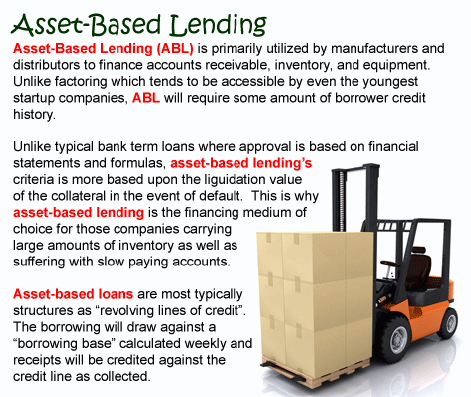
What is an Asset-Based Loan? Typically, asset-based loans are based on the value of a business’ assets, specifically, accounts receivable and inventory.
If for example, a business is highly leveraged or undercapitalized, an asset-based loan may provide a viable source of operating capital. This type of financing is based on the liquidation value of the account receivable and inventory and not the cash flow of the business. This is important when a business is over-leveraged i.e., too much debt and cannot afford additional debt.
Generally, asset-based loans are less difficult to obtain if a business has the following:
- Good financial statements,
- Customers who pay their bills,
- Good reporting system, and
- Quality and relative liquid inventory
An asset-based loan is a revolving loan since receivables and inventory are typically cyclical. Uses for this type of financing are as follows:
- Working capital,
- Equipment purchases,
- Cash flow
A lender, when analyzing how much to lend will lend between 25% to 40% of the value of the inventory or 75-80% of the value of the business’ receivables.
If you are considering an asset-based loan to help with working capital in order to meet your current obligations, please give me (Calvin R. Tucker) a call. I can be reached by telephone at 215-452-0100 or email at calvin@wpfsi.com.
Not sure if you’ll qualify? No problem, prequalify by answer 5 simple questions. Go here for details, Find Out If Your Business Qualifies for a Loan!
The post Can a Small Business Benefit from an Asset-Based Loan? appeared first on WPFSI.
]]>